

Step 1: Begin be drawing a circles that comes to a point for the beak and then ends close to where you started for the neck.

Step 2: Add detail to the head. Add a circle for the eye and lines for the beak

Step 3: Extend the neck to the body. Leavr a small space for legs

Step 4: Add the wing. Make a large curved line, and then within the curved lines, draw smaller straight lines to create feathers.

Step 5: Draw the tail, which is another series of slightly-curved lines

Step 6: Using the space from Step 3, draw the legs. Remember that birds' legs are very thin and have three toes.
Interesting Facts about the Great-Spotted Woodpecker
Great spotted woodpecker belongs to the woodpecker family. They are mainly found in Northern Asia and Europe. It is 23-26cm long with a wingspan of 38-44cm and weigh about 70-98kg. Their rear part is black in color and has white under parts with a black crisscross pattern running on their body. They also have a distinct red spot under their tail and have greenish grey feet. It is easy to distinguish between males and females because males possess a distinct crimson patch on their neck that females lack. Females have a crimson mark on their forehead area. Their diet includes seeds, chicks, eggs, fruits, insects and rodents.
Did you know?
- You can spot great spotted woodpecker by identifying its ‘kick’ or drumming sound that it makes constantly while pecking on wood.
- It taps on the tree trunk and uses its gluey tongue to catch its prey from the cracks.
- This is the most common and abundant specie present from the family of Britain woodpeckers.
- Post mating, the male and the female woodpecker dig out a hole together which has a depth of 30cm, 4m high from the surface and has an oval access.
- The storage time for eggs is 16 days after which they hatch.
Lesson plan note: Take children out to a nearby park or zoo and let them observe birds. If you are lucky, you might find a woodpecker tapping its bill on the trunk of a tree. Or you can show children videos of woodpeckers excavating and creating a hole in the trunk using their beak.
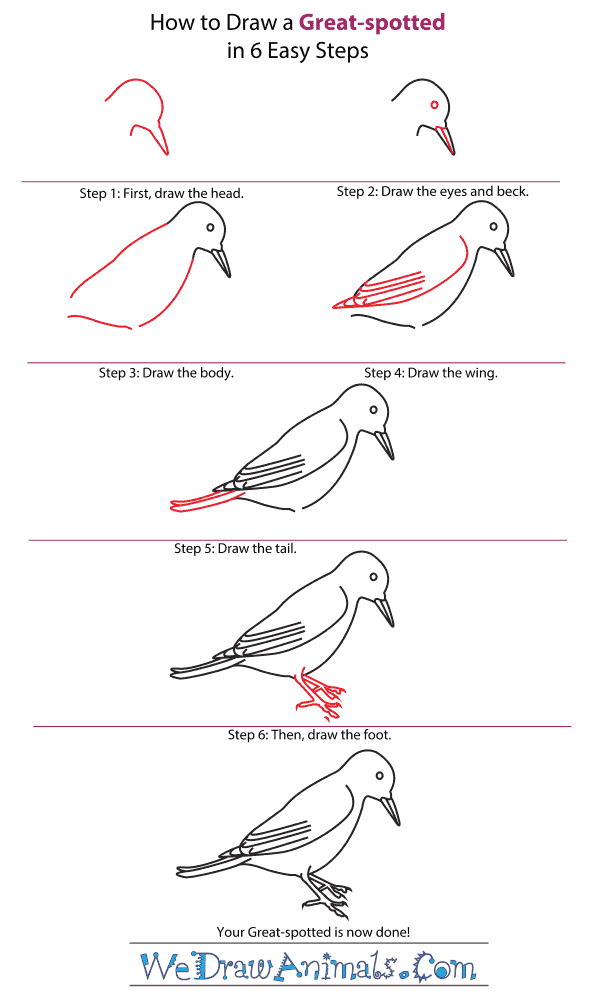
How to Draw a Great-Spotted Woodpecker – Step-by-Step Tutorial