

Step 1: Draw a curve with another, larger curve on it at the midpoint.

Step 2: Inside the point between the two, add a dot for the eye. Draw a curve from the bottom end of the head for the body.

Step 3: Draw a small line over the end of the bottom of the body. Draw a curve going up from the back of the head and a zig-zag going up from the rear of the body, meeting each other in an angle. Add another line going along the side of the curve.

Step 4: Draw another pair of curves going up and back from the bottom of the wing and rear of the body.

Step 5: Draw a long, narrow angle from the end of the body.

Step 6: Using the image as a guide, close off the gap between the tail and rear end with several horizontal lines meeting in a point and curving up under the tail. You have drawn a white-winged dove! You can color it brownish-grey with a white patch along the curve of the wings.
Interesting Facts about on White-Winged Dove
The White-Winged Dove can be found in North America and sometimes even Central and South America. It covers most of the United States, Canada and Mexico. The dove has also been seen in Puerto Rico as well.You can identify the White-Winged Dove with their light gray/brown bird with a white edge on the wing. It looks like a white stripe on the bird when the wings are folded on the leading edge of the wing.
Did you know?
- Flocks up to 1 million doves were observed feeding in grass fields in Texas.
- The doves help saguaro cactus by dispersing the seeds in feces or regurgitation to young.
- Their habitat is all deserts. In the Sonoran Desert they can be found living in shrubs, cholla cactus, mesquite, oak woods and crotches of saguaro.
- In wild the dove can live 10-15 years but in captivity, as long as 25 years.
- They can weigh about 5 ounces and reach a length of 11-12.5 inches.
White-Winged Doves have adapted to their environment a lot. They can fly 25 miles or more to find a water source. In the Sonoran Desert, they can be found eating and drinking moisture from the saguaro cactus fruit. When they migrate, they will travel in up to 4,000 birds to a nesting site.
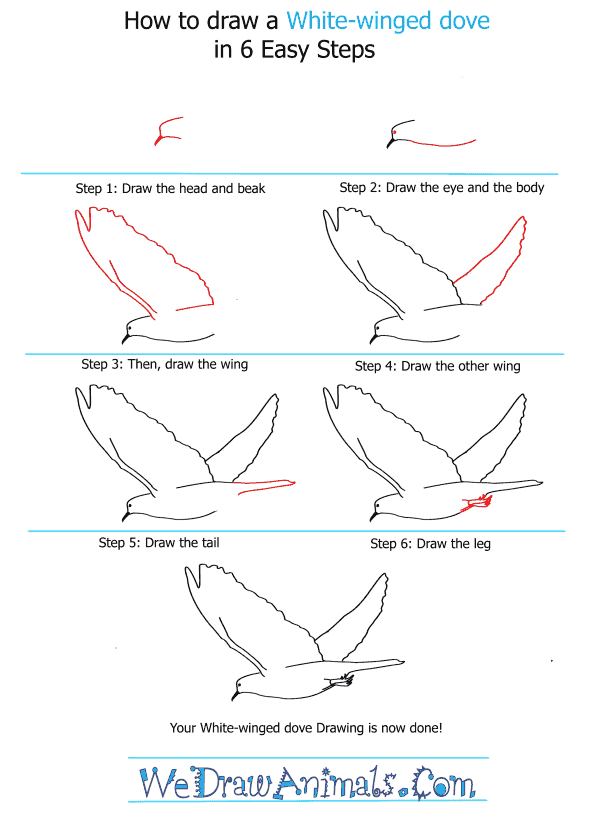
How to Draw a White-Winged Dove – Step-by-Step Tutorial